Septic tank pumping means a vacuum truck sucks the settled sludge and floating scum out of your tank through the manhole. How often depends on sludge and scum build-up, tank size and household use; one Gauteng operator's guidance is every 12 to 18 months for a normal household. The hose has to reach the manhole, and one operator asks for access within 30 metres.
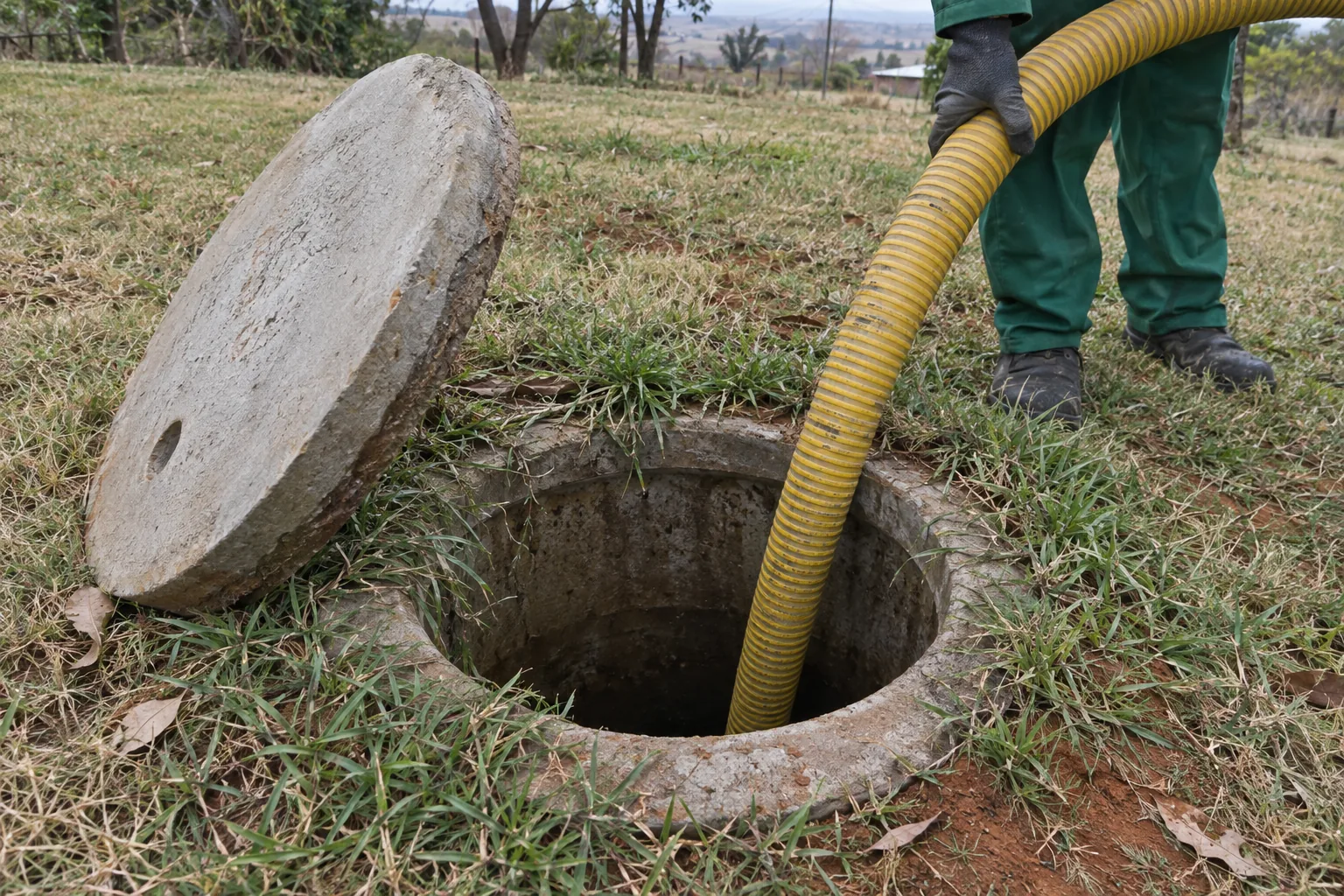
What actually happens during a pump-out?
A pump-out is a vacuum truck, a long suction hose and a cover that has to come off. The truck, often called a honeysucker, parks as close as it can get. The operator opens the manhole, runs the hose in and sucks the tank out into the truck. You get a slip that should show the litres removed.
The hose is the limit. One operator that works across Pretoria, Centurion and Midrand asks for access to the manhole within 30 metres, and says its suction pipes reach up to 35 metres from the truck. That's one operator's access condition, not a rule for every truck. A Gauteng operator charges a surcharge when the tank sits more than 30 metres from road access. A Cape Town residents' association warns that a tank too far from where the truck can reach may mean a bigger truck has to be found, and a delay.
Three things make the visit quicker and cheaper:
- Locate the access cover. Find it and clear pot plants and loose items around it before the truck arrives. If it's buried under lawn or paving, say so in your request. Leave lifting the cover and opening the tank to the operator.
- Clear the route. Gates, low carports, long gravel driveways and estate rules for heavy vehicles all matter. Trucks vary in size; some operators run small trucks for tight spaces, others run tankers of 7,000 litres and more.
- Tell the operator your tank size if you know it. One Gauteng operator calls tank capacity the main thing that sets the price.
How often should you have your tank pumped?
It depends on sludge and scum build-up, tank size and how hard the household uses it, so ask the operator to assess your tank rather than relying on one fixed interval.
As one example, a Gauteng operator gives every 12 to 18 months for normal household use. The same operator says a person living alone might stretch it to about 24 months, while a family of six needs a pump-out every year. An undersized tank serving a full house can need attention as often as every three months in extreme cases.
National guides are more relaxed. One says every 1 to 3 years, another every 3 to 5 years. The gap between those numbers is the point: no calendar knows your tank. What decides it is how much sludge has built up, which an operator can check when the cover is off.
Two practical rules for Pretoria smallholdings and older estates:
- If nobody knows when it was last pumped, arrange an inspection and ask whether pumping is needed. New owners rarely get a pump-out history with the title deed.
- Keep the slip. The date and the litres on it tell the next operator, and the next buyer, more than any guess.
Overflowing or backing up? What to do now
Sewage coming up a shower drain or out of a toilet is the emergency case. Here is what to do in the next ten minutes.
- Stop using water. No washing machine, dishwasher, bath or shower. Every flush adds to the problem.
- Keep children and pets away from any wet patch, the tank area and the affected bathroom.
- Leave the tank closed. Don't lift the cover or lean in. Never enter a septic tank or try to rescue someone inside one. Gases and lack of oxygen can kill.
- Call 060 086 9889 or send a request and pick "urgent problem". A vetted local septic operator in your area calls you to confirm the price and a time. If we miss your call, leave a message and we'll call you back.
While you wait, locate the access cover and clear loose items around it, so the operator can get to it. Opening it is the operator's job.
A word on timing. Weekend and after-hours call-outs cost more: one Gauteng operator says 30 to 50% on top of its standard rate. If sewage is in the house on a Friday evening, that premium is worth paying. If it's a mild smell and every drain still runs, a weekday booking is the cheaper call.
What should you ask the operator before the truck comes?
Five questions protect you from most pump-out disputes. Ask them on the phone, before anyone drives out.
- "Is your price per load or per litre, and what tank size does it cover?" The charge can depend on the volume removed, the number of loads and how difficult the contents are to pump. Johannesburg's by-law, for one, bases its own emptying fees on the quantity removed by the vacuum tanker.
- "Will the slip show the litres pumped?" If the number is more than you expected, ask how the volume was measured, and note any disagreement on the slip. A Cape Town ratepayers' association suggests photographing the slip.
- "Where does the sludge go?" The answer should be a municipality-approved disposal site. One Gauteng operator states that its loads go to council-approved sites and that legal disposal is in its base rate.
- "Are you authorised to cart sewage?" In Tshwane, the Sanitation By-laws say anyone carting sewage must be authorised to do so, and may offload it only at a facility allowed to accept it. A good operator answers without hesitating.
- "Are there extra charges?" Ask about distance beyond their service area, tanks more than 30 metres from the road, and after-hours rates.
What will a pump-out cost?
A quote broker's published range for emptying a 3,000 litre tank in Pretoria is R2,300 to R3,300. A Gauteng operator lists R2,500 excluding VAT for standard tanks up to 5,000 litres. Your quote depends on tank size and access, so treat these as a sense check, not a price.
The septic tank pumping cost guide sets out every range we could find with its source and date, what pushes the price up, and how a conservancy tank compares over a year.
Sources for the figures on this page
- Every 12 to 18 months; ~24 months for one person; annual for a family of six; undersized tank as often as quarterly in extreme cases; weekend and after-hours add 30 to 50%; surcharge beyond 30 m from road access; per-km charges beyond service radius; tank capacity the primary cost driver; disposal at council-approved sites included in base rate; R2,500 excl. VAT up to 5,000 L (published 4 Feb 2026) septictankpumpinggauteng.co.za
- Manhole access within 30 m; suction pipes up to 35 m; small trucks for smaller spaces; pump as soon as bad odours occur or draining takes longer than normal (checked 5 Nov 2026) suckaseptic.co.za
- Tank too far from honeysucker access may need a larger truck and cause delays; photograph the slip (Noordhoek Ratepayers, Cape Town, May 2026 v9) nrpa.org.za
- Pumping trucks of 4,000 L, 7,000 L and 25,000 L (Eastern Cape operator, example of truck sizes) biggsplumbers.co.za
- Pretoria 3,000 L pump-out R2,300 to R3,300; pump every 1 to 3 years (quote broker, undated, checked 5 Nov 2026) frenchdrain.co.za
- Sludge removal every 3 to 5 years depending on size and household usage (Kandua, summary labelled 2025) kandua.com
- Johannesburg emptying fees based on the quantity removed by vacuum tank (City of Johannesburg Water Services By-laws s.70) joburg.org.za
- Sewage carriers must be authorised and offload only at an authorised facility (s11(2), s11(4)); waste removal needs a NEMWA licence and the City's authority (s7(9)) archive.opengazettes.org.za
- Septic tanks produce gases including hydrogen sulphide and methane www.epa.gov
- French drain in clay with percolation over 30 minutes will clog and fail (Sitekiln SANS 10400-P summary, fact-checked 21 Jun 2026) sitekiln.co.za
- Signs: bad smells, soggy patches, slow drains, clogged toilets wolfplum.co.za