A complete septic tank installation in Gauteng typically costs R30,000 to R65,000, according to Kandua's cost guide. Before anyone digs, the system must meet SANS 10400-P, through its deemed-to-satisfy rules or a design by a competent person, and be approved by your municipality. For the plumbing work, a PIRB Licensed Plumber issues the plumbing Certificate of Compliance. Your quote depends on tank size, soil and access.
When do you need a new septic tank?
Most installs in Greater Pretoria start with one of four situations.
- A new build with no sewer. Smallholdings and plots in Pretoria East and North, parts of Centurion and the Midrand estates often have no municipal sewer to connect to.
- A tank that has failed. Cracked, collapsed or simply too small for the house it now serves. An undersized tank can need pumping as often as every three months in extreme cases, which gets old quickly.
- An old pit or homemade system. Replacing it with a designed tank and drain is an install, with the same approvals as a new one.
- The French drain has died. Sometimes the tank is fine and only the soakaway needs replacing. That's a smaller job; see French drains and soakaways.
One more case runs the other way. If the municipal sewer reaches your property and the tank is no longer needed, Tshwane's building by-laws say the owner must disconnect it and have it completely removed or filled with earth. Johannesburg's water by-laws say much the same. So a tank isn't always forever.
Why does approval come before the spade?
A septic tank needs your municipality's permission, a design that meets the national building rules, and a licensed plumber's certificate. Here is what each of those means, in plain words.
Municipal permission. In the City of Johannesburg, which covers most of Midrand, the water by-laws say no person may construct, install, maintain or operate a septic tank "without the prior written permission of the Council". The same by-laws let the council decide, at its discretion, whether a French drain is allowed, with regard to the soil and how well it drains. In Pretoria and Centurion, the City of Tshwane's building by-laws treat the use of a septic tank as something the municipality gives permission for, and can withdraw.
SANS 10400-P design. Part P of the National Building Regulations covers drainage. A SANS 10400-P summary explains that the local authority assesses the drainage at plan approval and inspects the pipework before it's covered. There are two routes to meeting it: follow the standard's deemed-to-satisfy rules, or have the system designed by a competent person. The summary describes a Competent Person (Sanitation) as a registered professional engineer or engineering technologist with sanitation experience. For premises other than a house, some by-laws require a professional engineer registered with ECSA to design and certify the tank.
The plumber's Certificate of Compliance. For the plumbing work, a PIRB Licensed Plumber issues the plumbing Certificate of Compliance. The Plumbing Industry Registration Board (PIRB) says only its Licensed Plumbers can issue these certificates.
What this means for you: nobody can approve an install over the phone, and that includes this site. Your installer or designer submits the plans; the council approves them; a licensed plumber signs off the plumbing. If someone offers to skip the approval to save a few weeks, that's your cue to find someone else. Pipework that gets covered before the inspector sees it may have to be dug up again, at your cost.
Which tank type and size do you need?
The two common options are plastic (polyethylene) and concrete.
- Plastic tanks in the 1,700 to 2,500 litre range cost R7,000 to R15,000 for the tank alone, according to Kandua. They don't rust and resist cracking.
- Concrete tanks cost more, per the same guide, which gives no figure.
Sizing is your designer's job, against the relevant design criteria. The figures you'll see are examples, not a rule of thumb. Kandua's guide sizes by bedrooms and uses a 2,000 litre tank for a three-bedroom house as its example. One Gauteng operator notes that homes with five or more bedrooms often have 8,000 to 10,000 litre tanks. The SANS 10400-P summary puts the minimum for a dwelling at about 1.5 cubic metres (1,500 litres), sized to hold one day of sewage.
Where it goes matters too, and here even the guides disagree. The SANS summary gives at least 2 metres from any boundary or structure; Kandua's guide gives 5 metres from any building. Treat both as examples a designer checks. That gap is exactly why the design should be done to the current SANS text, by someone who signs their name to it.
Does your plot pass the percolation test?
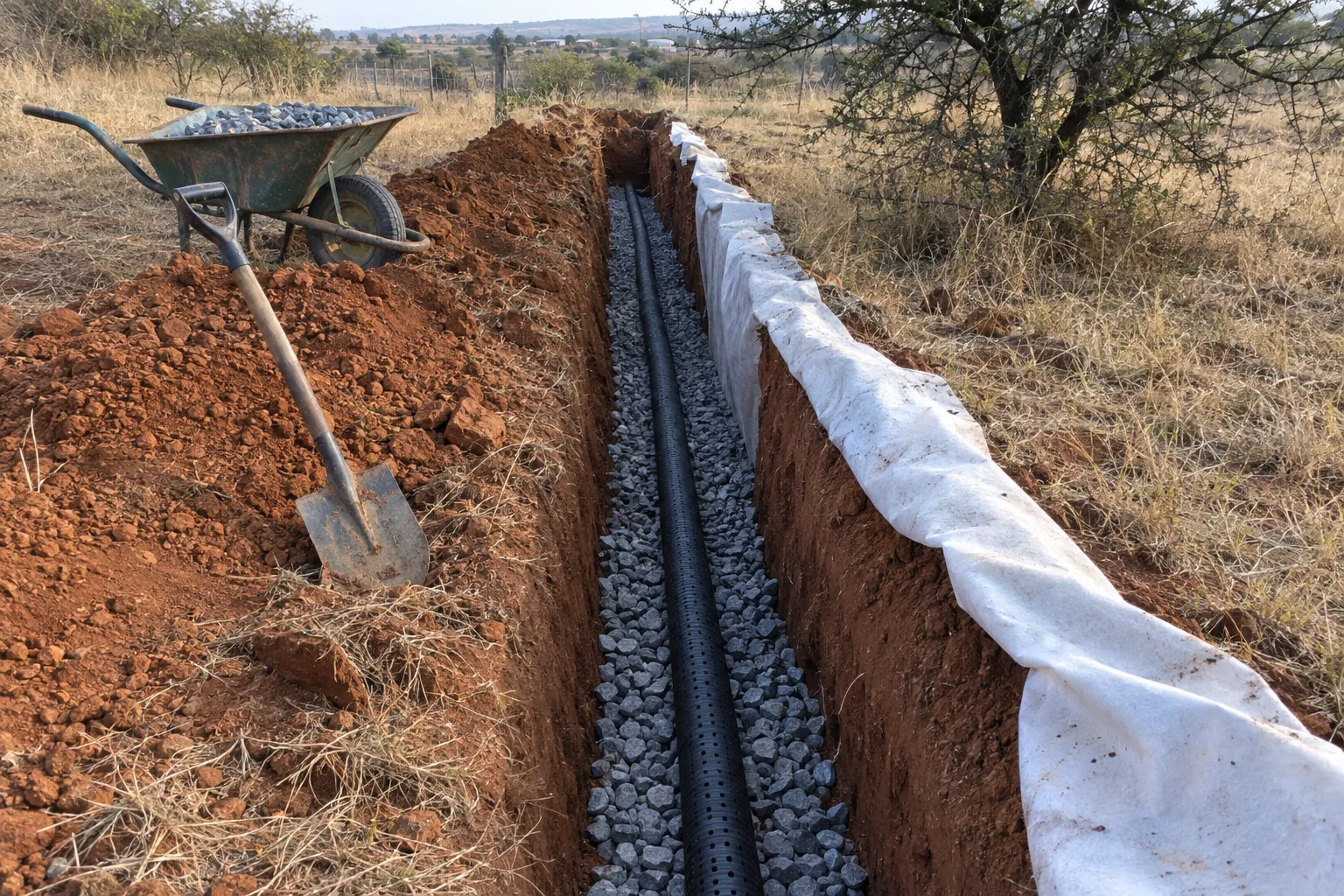
The tank only settles the solids. The wastewater then has to soak into the ground through a French drain or soakaway, and whether your soil can take it is what the percolation test measures.
The SANS 10400-P summary gives example figures that a designer checks against the current standard and your site: a percolation result of 30 minutes or less, at least 3 metres from any building or boundary, and no deeper than 1.8 metres. The test method and site conditions matter, so these aren't numbers to dig by. The same summary warns that a French drain built in clay that drains slower than that will clog and fail.
On a smallholding with a borehole, ask about the distance between the two. Kandua's guide gives at least 50 metres from a water source such as a borehole or well, and 10 metres from buildings, as its examples. Your designer confirms the distances for your plot.
Kandua puts the percolation test and design at R2,500 to R5,000 and the soakaway itself at R8,000 to R20,000 or more.
What does a septic tank installation cost?
All figures below come from Kandua's septic installation cost guide, whose summary is labelled 2025. Treat them as a planning range. Your quote depends on tank size, soil, slope, rock and access.
| Item | Published range |
|---|---|
| Complete installed system, Gauteng (Johannesburg and Pretoria) | R30,000 to R65,000 |
| Typical installed system, South Africa | R25,000 to R70,000, average about R45,000 |
| Easy site (level, sandy, good access) | R25,000 to R40,000 |
| Complex site (sloped, rocky, poor percolation) | R50,000 to R90,000 or more |
| Plastic tank only, 1,700 to 2,500 L | R7,000 to R15,000 |
| Excavation for tank and trenches | R5,000 to R12,000 |
| Piping and fittings | R2,000 to R4,000 |
| Soakaway (drainage field) | R8,000 to R20,000 or more |
| Percolation test and design | R2,500 to R5,000 |
| Extra rock or unsuitable soil removal | R2,000 to R5,000 |
Tank price versus installed price. The septic tank prices you see at a hardware store are for the tank alone. The tank is usually the smaller part of the bill; digging, the drain, the test, the design and the council submission make up the rest.
What should you ask an installer?
Seven questions sort the careful installers from the rest.
- Who draws the design, and who submits it to the council?
- Does the design follow the SANS 10400-P deemed-to-satisfy rules, or is it a design by a competent person?
- Will a PIRB Licensed Plumber issue the plumbing Certificate of Compliance? Ask for the plumber's name and PIRB licence number, in writing.
- Does the quote include the percolation test, design, council submission, excavation and any rock removal?
- How did you size the tank, and against which design criteria?
- Where will the French drain go relative to my borehole, buildings and boundaries?
- What happens to the price if the council or the inspector asks for changes?
Sources for the figures on this page
- Gauteng installed R30,000 to R65,000; national R25,000 to R70,000, average about R45,000; easy site R25,000 to R40,000; complex R50,000 to R90,000+; poly tank 1,700 to 2,500 L R7,000 to R15,000; concrete costs more; excavation R5,000 to R12,000; piping R2,000 to R4,000; soakaway R8,000 to R20,000+; perc test and design R2,500 to R5,000; rock removal R2,000 to R5,000; size by bedrooms; 2,000 L for a 3-bed example; tank 5 m from buildings; soakaway 10 m from buildings and 50 m from a borehole or well; formal municipal approval required (Kandua, summary labelled 2025, checked 5 Nov 2026) kandua.com
- Drainage assessed at plan approval and inspected before covered; minimum about 1.5 cubic metres for a dwelling, one day's retention; tank 2.0 m from boundary or structure; French drain 3 m from building or boundary, max 1.8 m deep, only where perc result is 30 minutes or less; clay over 30 minutes clogs and fails; deemed-to-satisfy rules or design by a Competent Person (Sanitation) (Sitekiln SANS 10400-P summary, fact-checked 21 Jun 2026) sitekiln.co.za
- Only PIRB Licensed Plumbers can issue PIRB Certificates of Compliance www.pirb.co.za
- Johannesburg: prior written permission of the Council to construct, install, maintain or operate a septic tank (s.65); French drain at Council's discretion having regard to soil permeability (s.66); disused tanks removed or filled (s.71) (City of Johannesburg Water Services By-laws) joburg.org.za
- Tshwane: permission for the use of a septic tank; when no longer required or permission withdrawn, owner must disconnect and remove or fill with earth (s.13, City of Tshwane consolidated building by-laws) www.tshwane.gov.za
- Premises other than a dwelling: tanks designed and certified by an ECSA-registered professional engineer (municipal by-law reported by SACAP, 22 Jun 2021) www.sacapsa.com
- Undersized tank may need attention as often as quarterly; 5+ bedrooms often 8,000 to 10,000 L (published 4 Feb 2026) septictankpumpinggauteng.co.za