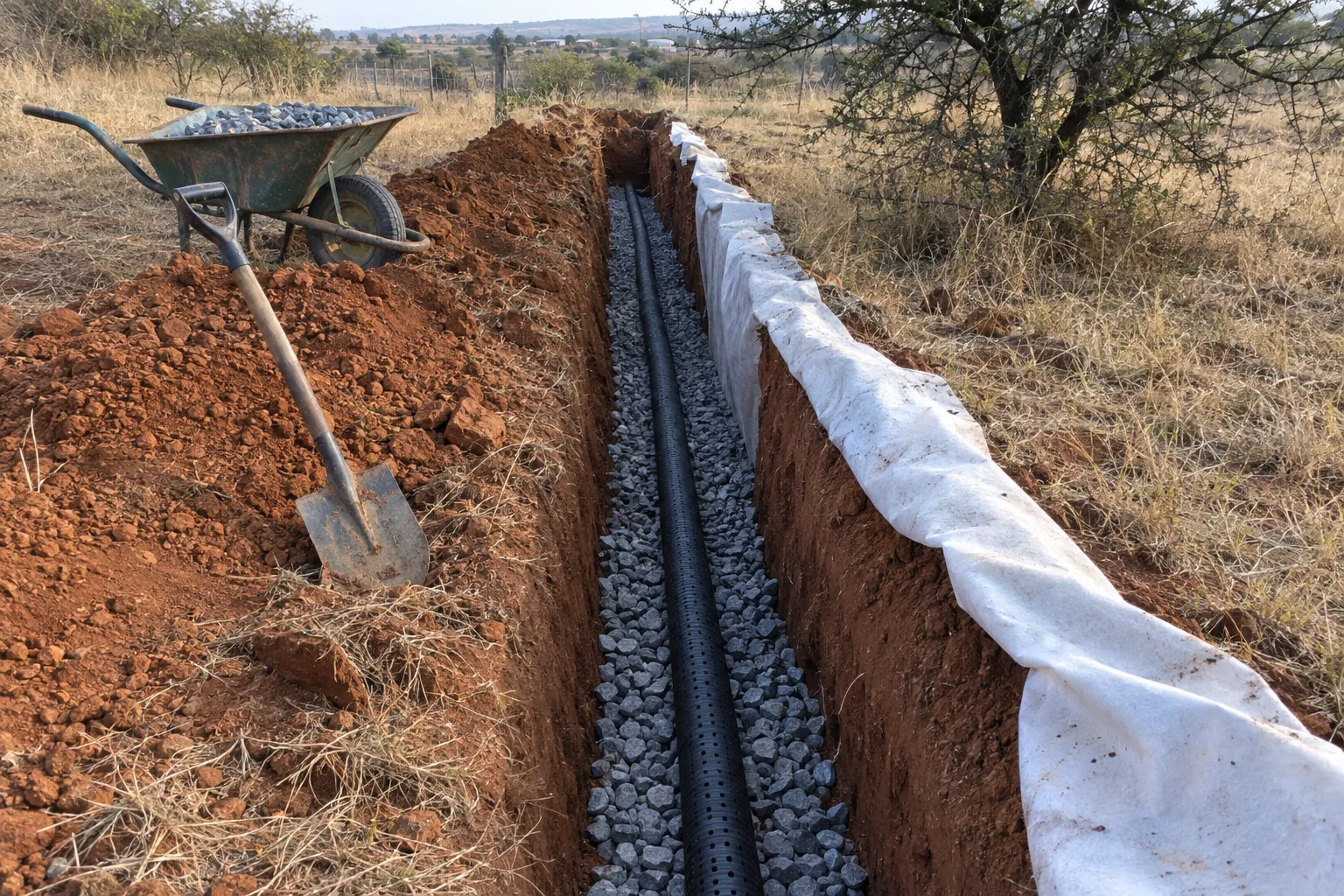
A French drain, also called a soakaway, is the gravel-filled trench or pit that takes the liquid out of your septic tank and lets it soak into the ground. If the soil around it stops absorbing, effluent can surface or the drains keep backing up even after a pump-out, and more pumping won't fix it.
What does a French drain actually do?
Your septic system has two jobs, and the tank only does the first one.
The tank holds the sewage long enough for solids to settle and bacteria to break them down. The liquid that's left flows out the other side. One Gauteng installer describes it being "channelled through perforated pipes to different parts of a field of loose gravel". From there it seeps into the soil.
Think of the tank as the settling dam and the French drain as the sponge. When the sponge is full, the dam backs up.
The national drainage standard, SANS 10400-P, sets the ground rules, and a designer applies them to your site. As examples, a summary of it says a French drain should be at least 3 metres from any building or boundary and no deeper than 1.8 metres, and should only go where a percolation test (a timed check of how fast water drains into a test hole) passes in 30 minutes or less. These are figures for the designer to check, not instructions to dig by.
Signs your French drain has failed
A soggy patch that won't dry
Wet, spongy ground or standing water over the drain area, even in a dry spell. A US septic guide reads this as soil that "cannot absorb effluent".
A smell outside
Installers list "bad smells around drains or outside" among the classic warning signs. Near the drain field, it can point to liquid surfacing instead of soaking away.
Effluent at the surface, or a level that stays high
A tank that refills after a pump-out is normal: a working septic tank sits full to its outlet level. The warning signs are effluent coming to the surface, or a liquid level the operator finds abnormally high. Both need the outlet, tank and drain area assessed.
Slow drains that come straight back
If drains were slow, the tank was pumped, and they're slow again within weeks, the guide's advice is to look downstream at the drain field.
Is it the tank or the French drain?
A full tank and a struggling drain look alike from inside the house. A pump-out helps tell them apart, though what follows is a pointer, not a diagnosis.
| What you notice | More likely the tank | More likely the French drain |
|---|---|---|
| Slow drains, then fine after a pump-out | Yes | |
| Slow drains or backups again soon after a pump-out | Yes | |
| Soggy ground over the drain area | Yes | |
| Tank was last pumped years ago | Yes |
When the tank has been pumped and the pipe from the house is clear, the US guide says "the problem is downstream in the drainfield". It also calls this the most expensive diagnosis, so it's worth ruling out the cheaper causes first.
Repair or replace?
Sometimes the fault is the pipe, not the ground. One Pretoria operator names a blocked French drain outlet as a cause of overflowing tanks. A blockage between the tank and the drain can often be cleared.
If the soil itself has stopped taking water, clearing won't help. The SANS 10400-P summary warns that a French drain built in clay where percolation takes longer than 30 minutes "will clog and fail". In that case the operator or plumber may suggest a new drain in fresh ground.
A new or rebuilt drain is new work, and it needs your council's say-so:
- Tshwane (Pretoria and Centurion) may permit a French drain "at its discretion", looking at the effluent and "the nature and permeability of the soil".
- Johannesburg (most of Midrand) applies almost the same test in its Water Services By-laws.
On cost, a national guide puts a French drain or soakaway at R8,000 to R20,000 or more, and a percolation test with design at R2,500 to R5,000. Your quote depends on soil, size and access.
Why pumping alone won't fix a dead drain
A pump-out empties the tank. It does nothing to the ground.
A working tank refills after every pump-out anyway; that part is normal. If the drain has stopped absorbing, the trouble shows up as backups, wet ground or effluent at the surface, and it comes back after each pump-out. The US guide puts it bluntly: "Pumping relieves the symptom but does not fix a structural problem."
That's how people end up paying for a pump-out every few weeks without noticing the pattern. If you're booking the truck far more often than you used to, ask the operator to look at the drain, not just the tank.
How to keep a French drain working
The US Environmental Protection Agency's care advice is short and practical:
- Don't park or drive on the drain field.
- Keep roof drains and other rainwater away from it.
- Keep trees and shrubs away, because roots damage the pipes.
On a smallholding that also means no horse boxes, bakkies or builders' rubble over the drain. If you don't know where yours is, ask the operator to point it out at the next pump-out.
Ask about a French drain problem
Tell us what you're seeing. We pass your request on. A vetted local septic operator in your area calls you to confirm the price and a time.
Prefer to talk? Call 060 086 9889. If we miss your call, leave a message and we'll call you back.
Sources for the figures on this page
- Liquid "channelled through perforated pipes to different parts of a field of loose gravel" classen.co.za
- French drain at least 3 m from building or boundary, no deeper than 1.8 m, percolation test 30 minutes or less; clay over 30 minutes "will clog and fail" sitekiln.co.za
- "cannot absorb effluent"; slow drains again after pumping, look downstream; "the problem is downstream in the drainfield"; most expensive diagnosis; "Pumping relieves the symptom but does not fix a structural problem" theseptic.guide
- "Bad smells around drains or outside" wolfplum.co.za
- Blocked French drain outlet as a cause of overflow suckaseptic.co.za
- Tshwane French drains at the City's discretion, soil permeability; "French drains, soakage pits or other approved works" archive.opengazettes.org.za
- Johannesburg French drain at Council's discretion, soil permeability openbylaws.org.za
- French drain or soakaway R8,000 to R20,000+; percolation test and design R2,500 to R5,000 kandua.com
- Don't park or drive on the drain field; keep roof drains away; keep trees and shrubs away www.epa.gov